
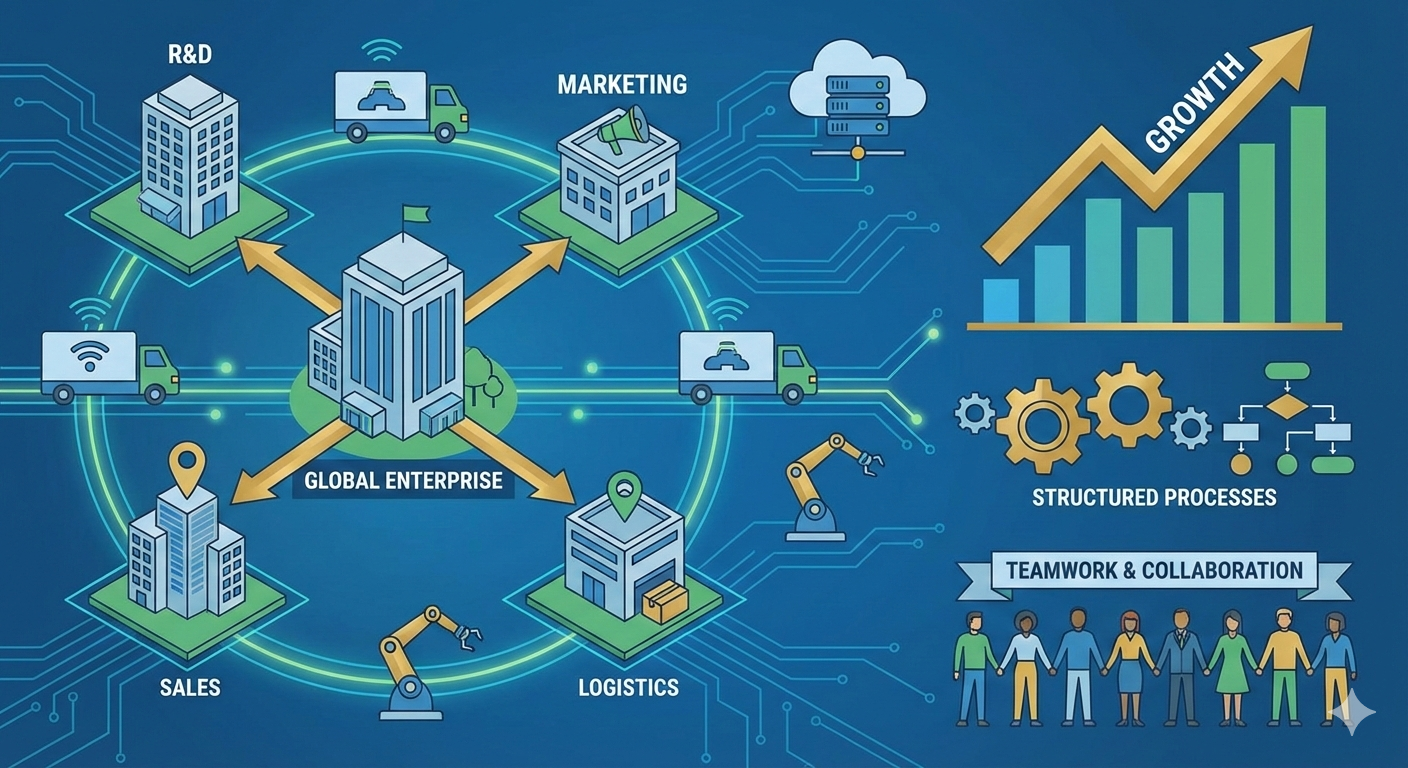
Scaling a business is not just about growing bigger — it’s about growing smarter.
Large companies succeed by expanding operations while maintaining quality, efficiency, and profitability.
Let’s see how they do it.
1. Standardizing Processes
Large companies document and standardize workflows so that:
- Tasks are performed consistently
- Errors are reduced
- New teams can be trained quickly
- Quality remains stable
Standard processes make scaling smoother.
2. Leveraging Technology and Automation
Automation helps companies scale without chaos.
They use:
- ERP systems
- CRM software
- Automation tools
- AI-driven analytics
Technology increases speed and accuracy.
3. Building Scalable Infrastructure
Corporations invest in:
- Cloud systems
- Scalable IT architecture
- Flexible supply chains
- Robust logistics networks
This ensures growth doesn’t break operations.
4. Hiring the Right Talent
Scaling requires skilled people.
Large companies focus on:
- Hiring specialists
- Developing leaders
- Training employees continuously
- Building strong teams
People power fuels operational expansion.
5. Strong Supply Chain Management
Efficient supply chains ensure:
- On-time delivery
- Cost control
- Quality assurance
- Inventory optimization
Well-managed supply chains support growth at scale.
6. Data-Driven Performance Tracking
Companies track:
- KPIs
- Productivity metrics
- Customer satisfaction
- Operational efficiency
Data helps identify bottlenecks early.
7. Maintaining Quality Control
Scaling should never reduce quality.
Corporations implement:
- Quality assurance systems
- Regular audits
- Customer feedback loops
Consistency protects brand reputation.
8. Gradual and Strategic Expansion
Successful companies scale step-by-step, not blindly.
They:
- Test markets
- Expand region by region
- Optimize before expanding further
Smart growth prevents costly failures.
Conclusion
Efficient scaling is a balance of people, process, and technology.
Companies that scale wisely grow stronger — not just bigger.
“Scale is powerful when supported by systems.”